


Comparing volumetric and thermal flowmeters for assessing and validating liquid chromatography performance
Carlo Dessy, Testa Analytical Solutions e.K.
Published in International Labmate – February 2025

Assessing and validating the performance of a pump serving HPLC, UHPLC, Ion Chromatography or GPC/SEC system is a crucial task in many laboratories nowadays. For thls purpose, accurate determination of flow rate is a powerful tool. Using a real time flowmeter, flow tate monitoring of liquid chromatography systems has been demonstrated to be a powerful diagnostic tool, allowing fast detection of leaks, faulty check-valves and worn seals. Traditionally, flow rate determination involves manually timed measurement of the volume or weight of the solvent delivered by the pump using a stopwatch, a scale, or a graduated cylinder. The necessity for very accurate timing in combination with volume or weight measurement techniques makes both methods impractical for use in modern laboratories short on time and trained personnel.
These taditional techniques are also prone to human error, which may have a significant impact on the results. Consequently, using automatic flowmeters, capable of real time measurement of flow rate without direct human intervention, is increasingly becoming the technique of choice. An additional advantage of thie new generation of flow measurement devises is the much better documentation of the process undertaken and results obtained, which is particularly important in quality sensitive environments in regulated industries.
Commercial volumetric flowmeters
A volumetric flowmeter is the automated version of the classical 'Stopwatch and graduated cylinder' method. A flowmeter of this type consists of a tube and two optical level sensors placed at a known distance from each other. The time the solvent front makes to travel from one light trap to the next is a function or the flow rate and the volume of the tube which is constant. After each measurement is completed, the tube must be automatically emptied so that the measurement can be repeated. As such, e volumetric flowmeter is not capable of continuous measurements.
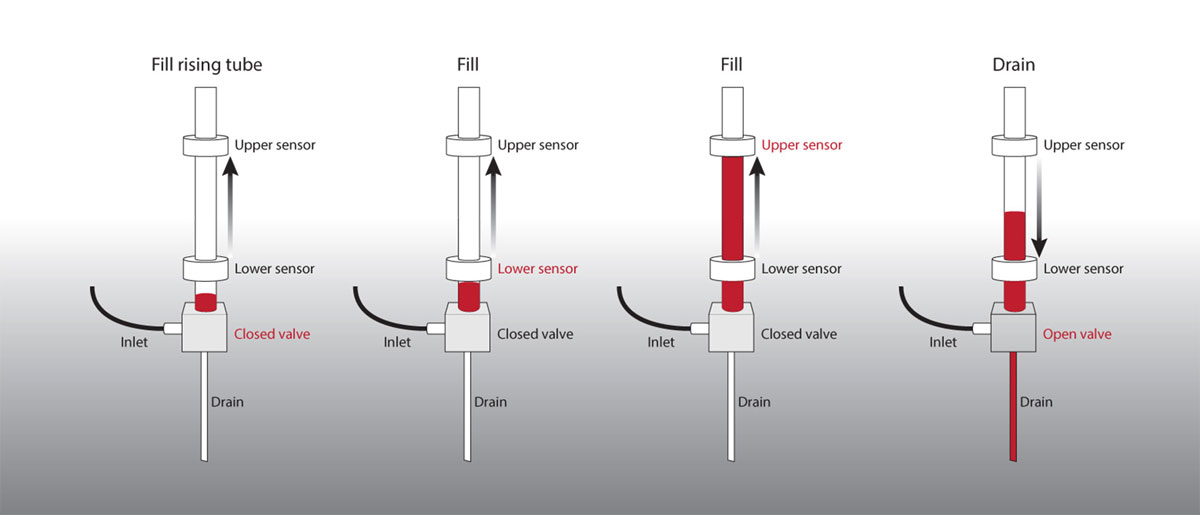
For analytical purpose, volumetric flowmeters must be positioned perfectly vertically and at the end of a liquid chromatography system. As a result, their use is limited to confirmation of performance of the pump, no real diagnostics are possible as eech value reported is not related to the previous one.
Furthermore, as the flow rate is averaged over the measurement volume, you cannot determine pulsations or variations in flow with a duty-cycle shorter than the time required to fill the volumetric tube. However, this technique has been proven to be very reliable in determining the flow late of aqueous HPLC separations. Unfortunateły, the different surface tensions of other solvents do not allow volumetric tubes to be voided with the same effricacy as with water.
Volumetric flowmeters are commonly used in conjuction with HPLC systems as validation tools. It should however be noted that because they are based on the measurement of time required to fill a known constant volume, that the accuracy of results decreases markedly at higher flow rates.
A new generation of thermal flowmeters
Thermal flowmeters were one of the first instruments used for the maesurement of flow rate in liquid chromatography. The method these devices used is based on the measurement of the difference in temperature between two temperature sensors, one placed upstream of a heating element and the other placed downstream of it.
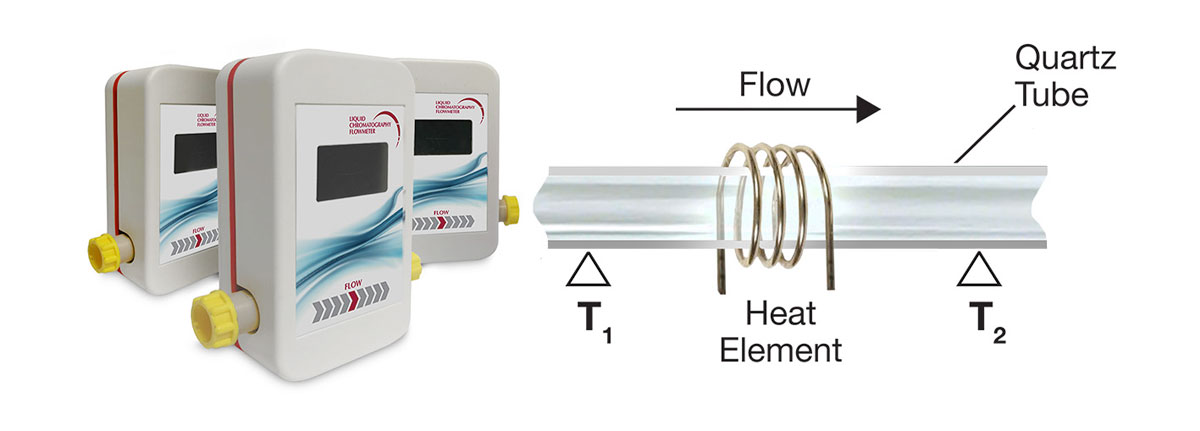
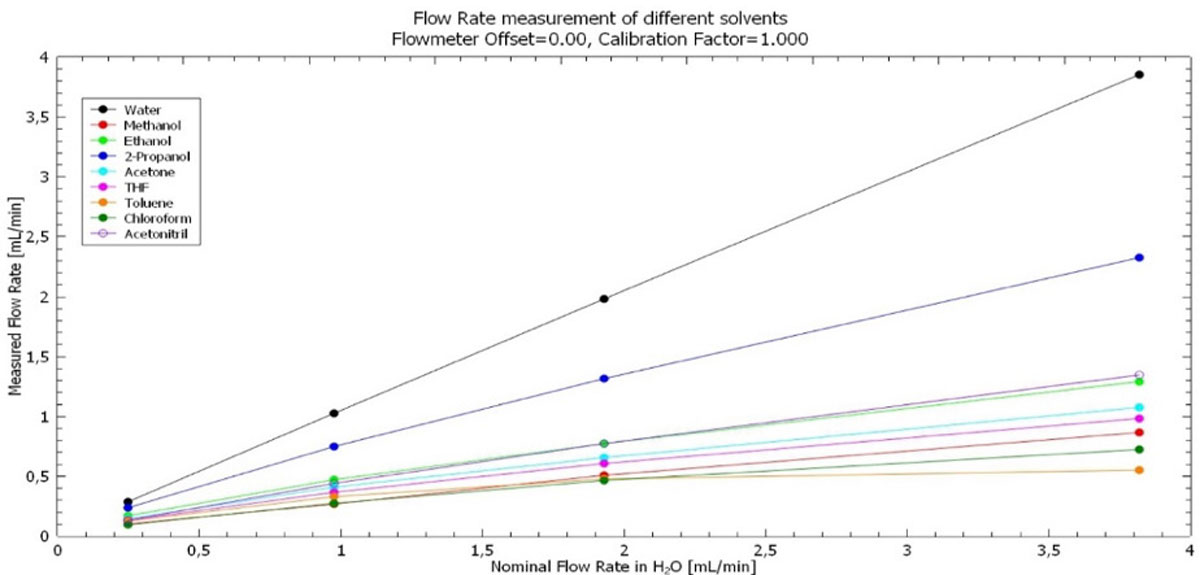
For applications with a flow rate of a few microliters per minute up to several millilitres per minute, thermal flowmeters typically employ a quarz flow measurement tube. Introduced in 2021, the new generation of thermal flowmeters from Testa Analytical have been demonstrated to work with virtually any solvent. Benefitting from advanced design and modern microelectronics, all components necessary for flow measurement using these devices are located on the outer wall of the quartz tube and have no contact with the liquid. Measurement using these devices therefor is completely non-invasive. These flowmeters come with five solvent calibration factors: water, methenol, THF, acetonirile water 40:60 and ethanol water 10:90. Other common solvents have been tested for compatability and the flowmeters can be calibrated accordingly upon request.
Being non-invasive, the thermal flowmeter ensures the unperturbed operation of the whole liquid chromatogaphy system. Measurement with thermal flowmeters is continuous, allowing use of these devices fr real-time monitoring of pump performance.
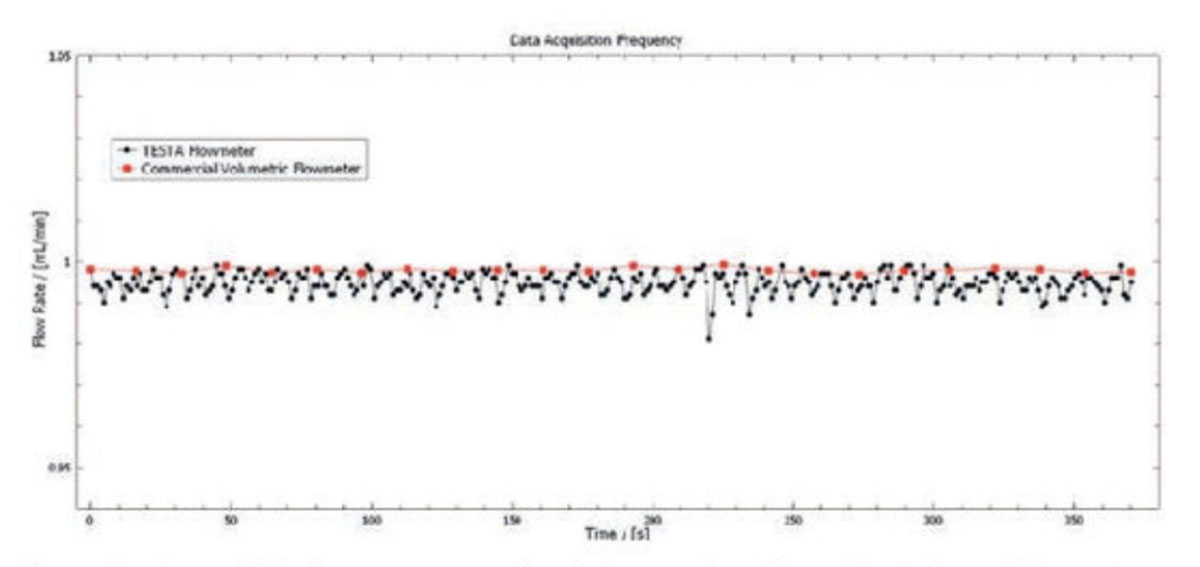
Unlike volumetric flowmeters which only offer a fixed data acquisition frequency for any given flow rate, frequency of data acquisition using a thermal flowmeter is independentt on the flowrate and can be selected allowing a high resolution of up to 12 data points per second.
The faster higher resolution data acquisition offered by the Testa Analytical thermal flowmeter not only can improve data quality but can also offer considerable saving of precious labour time in particular at low flow rates, where volumetric flowmeters are slow to generete a single datapoint.
In addition, using this new generation of digital thermal flowmeters, it is possible lo interface them directly with chromatography data system allowing storage of flow data along with each chromatogram from your liquid chromatography system. This technological advance opens a whole new chapter to the concept of total quality assurance, as each chromatogram may now be evaluated under the light of the flow rate delivered by the pump during that one chromatogram.
Conclusion
Historically volumetric flowmeters have been the technique of choice when the peformance of a liquid chromatography pump needed to be validated or qualified for a particular application. Their perfomance with aqueous separations at room temperature has made them a tried and trusted method. However, technological advances in real-time non-invasive thermal flowmeler design now make it possible to not only match the performance of any volumetric flowmeter, but also offer a range of exciting new benefits to the user. These new capabilities include wide-ranginq solvent compatibility, greater flexibility and, probably most important of all, a reduction in the time required for the validation or qualification task. Compact and lightweight in design, these thermal flowmeters are powered and transmit measured flow data in real time via an integral USB interface. A PC based app allows continuous recording and storage of the measured flow rates.
Thank You!

Your message has been forwarded to our team and we will reply as soon as possible. Thank you for your patience.
© 2026 TESTA Analytical Solutions e.K. All rights reserved.